A Region Transformed: Lessons from the 2021 Floods
The Ahr Valley in Germany, a region that bore the brunt of unprecedented flooding in July 2021, is currently undergoing a monumental transformation. Five years on, the landscape is dotted with construction sites, as billions of euros are invested not just in rebuilding, but in fundamentally reimagining how communities can coexist with a powerful, unpredictable river. The overarching goal is to implement advanced flood protection strategies, ensuring that such a disaster does not recur.
Alexandra Wiemer vividly recalls the night of July 14, 2021, describing water appearing to surge "from every direction." At approximately 10:30 p.m., the normally placid Ahr River, which traverses 85 kilometers from its mountain source to the Rhine, erupted. The region had experienced a month's worth of rainfall in just two days, turning a gentle stream into a destructive torrent. The force of the water was immense, sweeping away vehicles, homes, trees, and other debris, which subsequently demolished bridges. While Wiemer and her son managed to escape, 135 lives were lost, predominantly in her hometown of Bad Neuenahr-Ahrweiler. This town saw 80% of its area inundated, and the floods inflicted billions of euros in damage to both private residences and public infrastructure.
Engineering a Safer Future: New Defenses and Designs
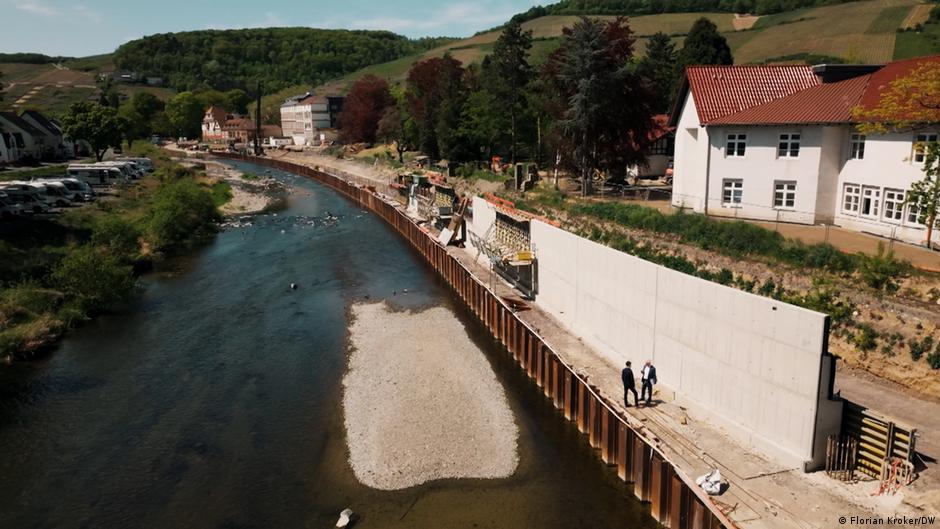
The reconstruction efforts in the Ahr Valley are extensive and multifaceted. One significant project is located in Bad Neuenahr-Ahrweiler, precisely where the floodwaters breached the ancient town wall. Here, a new 480-meter-long retaining wall is being erected. Hermann-Josef Pelgrim, managing director of the local reconstruction corporation, detailed its robust construction: "It's a very solidly anchored wall, built with bored piles 1.20 meters in diameter and driven 15 meters deep."
Beyond this prominent wall, numerous other, less visible, but equally crucial safety enhancements are being implemented. For instance, a new fire station is being constructed on underground stilts to bolster its resilience against collapse. Within the urban core, green spaces are being integrated with subterranean drainage trenches, designed to absorb and redirect heavy rainfall. The 16 bridges destroyed in 2021 are being redesigned with enhanced flood resistance in mind. The remnants of a medieval five-arch bridge will be preserved as a memorial, while its replacement will feature a single, wide arch to facilitate the safe passage of water and debris underneath. Pelgrim asserted, "This bridge will not collapse under any circumstances, even in the event of extreme flooding." He emphasized that preventing future disasters necessitates a collaborative, cross-community effort, noting, "We can prepare for what's coming our way. But it would be better if not so much came our way in the first place — and that's the responsibility of those further upstream."
Reclaiming Natural Spaces: The River's Role in Flood Mitigation
Historical maps from approximately 220 years ago reveal the Ahr River meandering freely across its valley floor, often in multiple branches. However, with increasing human settlement, the river was channeled, and construction occurred along its banks, leaving floodwaters with no alternative but to inundate developed and agricultural areas. The town of Altenburg, situated upstream from Bad Neuenahr-Ahrweiler, serves as a stark illustration. During the 2021 flood, water levels here surged to over 7 meters, a dramatic increase from the typical 70 centimeters. Aerial photographs from that period show only the uppermost floors of houses visible above the water.
Bruno Büchele, an engineer coordinating the waterway restoration, highlighted the primary challenge: restoring the Ahr to its natural spatial allowance. To achieve this, the county administration has acquired riverside plots from local farmers and private landowners, intending to re-establish these areas as floodplains. The plan involves planting these lands with shrubs, trees, and bushes. Büchele cautioned, however, that "these efforts will only be fully effective once retention measures technically reduce the volume of runoff arriving here." Both Büchele and Pelgrim advocate for flood prevention initiatives to commence even further upstream, proposing the construction of dams along the river and its tributaries.
Strategic Dams and Long-Term Visions
An existing dam in a side valley near Adenau exemplifies a successful flood mitigation strategy. This structure spans a stream, transforming the meadow behind it into a basin. During the 2021 flood, it impounded 40 million liters of water, remaining intact despite minor leakage, and prevented disaster in Adenau. A second nearby basin performed similarly. Inspired by this success, plans are underway for 17 additional, significantly larger dams, some reaching heights of 25 meters, along the Ahr and its tributaries. This ambitious project is projected to cost over €1.5 billion and is anticipated to span several decades, assuming smooth execution.
Interestingly, similar flood prevention plans for the Ahr Valley were conceived after another devastating flood in 1910 but were never actualized. Those plans faded from public memory, and allocated funds were redirected, including towards the construction of the Nürburgring racing circuit. This time, however, there is a renewed commitment to these long-term solutions.
Despite these extensive communal efforts, Alexandra Wiemer has also taken personal precautions. She relocated to a different house post-flood, where her basement windows are now equipped with flood barriers, and a stack of sandbags is discreetly positioned nearby. "These are precautions," she stated, "so that if anything happens, we can act quickly." Like many flood survivors, she chose to remain in the town, still close to the river. Her reasoning is straightforward: "Because it's nice to live by the water. And because I'm not afraid. Period."
Source: Germany's Ahr Valley: Rebuilding better after deadly flood