Bundesliga Forges New US Broadcasting Path
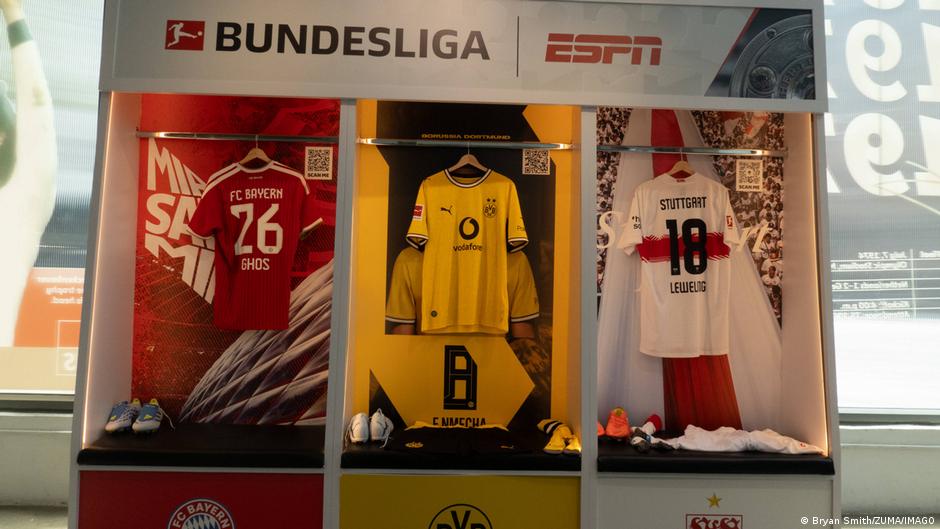
After a six-year tenure with ESPN, the Bundesliga, Germany's premier football league, has transitioned its English-language broadcasting rights in the United States. A new deal, reportedly spanning through the 2030-31 season, has been secured with a combination of USA Network and Fandango, both subsidiaries of Versant, a media company aiming to expand its sports content portfolio.
The reported value of this new agreement stands at approximately $20 million (€17.4 million) annually. This figure represents a notable decrease from the $34 million per year previously paid by ESPN, signaling a strategic shift in the league's approach to the American market.
Versant's Strategic Play and Fan Reactions
Versant, primarily known for Fandango's movie ticketing services, is actively seeking to diversify its offerings by integrating live sports. The new arrangement stipulates that all 300-plus Bundesliga matches will be aired across the USA Network, which requires a subscription, and Fandango, which will offer free, ad-supported streaming. This dual-platform approach aims to maximize viewership across different consumer preferences.
However, the announcement has been met with considerable negativity from US-based Bundesliga fans on social media. Many expressed concerns that the move could diminish the league's profile in the country. For example, @skierpro on X commented, "This will only make the Bundesliga even more obscure. Any momentum the league had in the US and growing viewership will be destroyed. The folks in Germany signing this agreement have no idea about the US it seems. They just shot themselves in the foot with this deal."
Another user, Corbin Williams, articulated, "This is bad. The simplicity of having every game on ESPN that already has a lot of other sports was perfect. Fandango, a company with nearly no sports streaming experience, may be free, but the games on USA will require an expensive YT TV, Fubo or similar package." Eric Smith echoed similar sentiments, stating, "SAD! USA is OK but Fandango is not a popular streaming app. ESPN was easily accessible. Games on Fandango is going to be like going to the bike shop to buy a BMW."
Prioritizing Reach Over Immediate Financial Returns
While the financial terms of the new deal represent a reduction, some analysts view this as a strategic decision focused on long-term growth. Dominik Schreyer, a professor of sports economics at Germany's Otto Beisheim School of Management, explained to DW, "From the outside, the new agreement appears to deliver less media-rights income per season but broader distribution, greater discoverability, and a better chance of reaching viewers beyond the Bundesliga's existing fan base. In essence, the reported financial return appears lower, but the potential reach is greater."
Schreyer acknowledged the disappointment from a business perspective regarding the reduced fee but emphasized the broader context. "The DFL is facing a difficult market reality. The media-rights market has become more selective, while competition for audience attention is intensifying. Maximizing the check from each individual cycle may therefore no longer be the only sensible objective," he stated. He added, "The new distribution model could still prove strategically valuable if its broader reach helps build a larger and more commercially attractive audience over time."
Previously, ESPN's coverage, including its roster of reporters and commentators, was often lauded by fans. However, Schreyer suggested that the Bundesliga might not have achieved sufficient prominence within ESPN's extensive sports offerings, potentially hindering audience expansion. "My best guess is that the previous model provided insufficient prominence within ESPN's crowded sports portfolio, potentially limiting audience growth," he posited. "The Bundesliga may now be more important to a partner seeking to establish and differentiate its own live-sports offering in an intensely competitive market, although we cannot know from the outside which considerations ultimately drove the change."
Challenges and Opportunities for Bundesliga in the US
Robin Austermann, Bundesliga Americas executive vice president, highlighted the growing interest in soccer in the US, particularly with the upcoming 2026 World Cup. "The 2026 World Cup has highlighted the tremendous growth potential of soccer in the US," Austermann noted in a statement, adding, "We've seen that momentum firsthand, with the number of Bundesliga fans in the US growing by 43% over the past five years."
Despite this growth, the Bundesliga faces inherent challenges in the market. The consistent dominance of Bayern Munich domestically often reduces competitive tension and suspense within the league. Furthermore, a perceived lack of global star players compared to other major leagues, coupled with Germany's recent underperformance in World Cups, has somewhat impacted German football's overall standing internationally. These factors complicate the Bundesliga's position when negotiating broadcasting deals.
Nevertheless, there is optimism that the momentum generated by the 2026 World Cup, co-hosted by the US, Canada, and Mexico, can be leveraged. Schreyer emphasized the importance of strategic implementation: "It now needs to use prominent scheduling, strong promotion, and localized storytelling to build consumption capital." He concluded, "Once viewers discover the product, repeated exposure helps them learn about the clubs, recognize the stars, understand the rivalries and gradually turn occasional viewing into habit, fandom, and ultimately commercial value."
Source: Original Article