Anish Kapoor's Evocative Art: Exploring Perception and the Void in New Exhibitions
Anish Kapoor, a distinguished figure in contemporary art, continues to captivate and challenge audiences with his profound exploration of perception, space, and materiality. His work often guides viewers to confront unsettling visual experiences, pushing the boundaries of what is seen and felt. Two significant new exhibitions offer fresh perspectives on his extensive career, inviting deeper engagement with his unique artistic language.
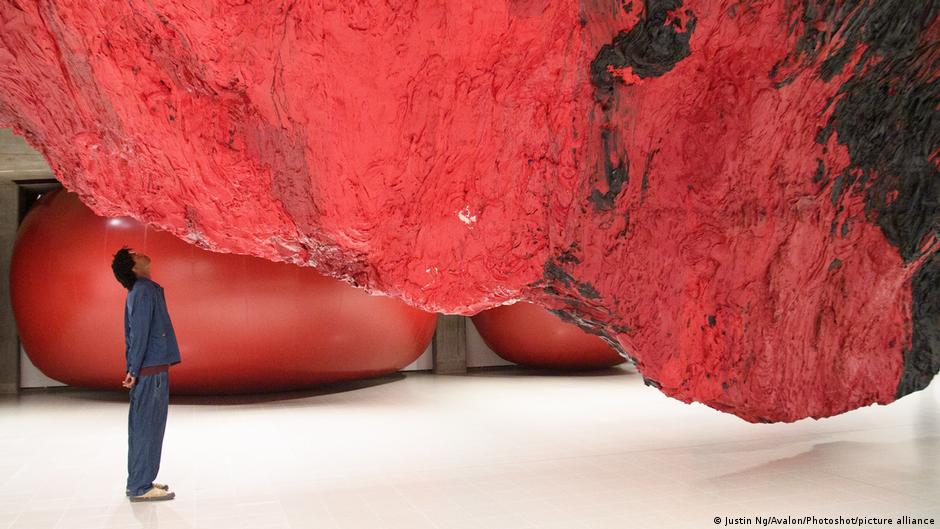
Kapoor's art frequently demands a degree of courage from its beholders. His use of deep, dark voids and the 'blackest of black' can evoke a sense of unease, depending on an individual's emotional state. Furthermore, his recurring incorporation of dark red wax, symbolizing flesh and blood, elicits powerful, primal associations. Despite the intense nature of his creations, Kapoor himself appears composed when discussing his work, though he admits to moments of personal disquiet, even with his own installations.
Currently, a major exhibition at the Lehmbruck Museum in Duisburg, Germany, features a sculpture titled 'First Body,' crafted from resin. In an interview with ARD, Kapoor described it as 'fleshy,' noting its 'rather strange' quality with a laugh and a shudder. This visceral reaction from the artist underscores his deeply intuitive approach to creation. Kapoor often begins his work without a clear endpoint in mind, allowing the materials to guide the process. He once shared with The Talks magazine, "I go into the studio and say, 'I don't know what to do. I'm lost.' Then stuff arises and it's the thing in the room that you work with." He values this method for its capacity to lead him in unexpected, non-rational directions.
A Global Presence: From Mumbai to Millennium Park
Born in Bombay (now Mumbai), India, in 1954, Anish Kapoor has established himself as one of the world's most recognized and sought-after artists. His accolades include the prestigious Turner Prize in 1991 and a knighthood from Queen Elizabeth II in 2013. Having resided in London for over five decades, he is currently the subject of a significant exhibition at the Hayward Gallery. Kapoor's works are permanently installed in numerous locations worldwide, seamlessly integrating into both urban and natural environments.
One of his most iconic public sculptures, 'Cloud Gate,' affectionately known as 'The Bean,' has been a fixture in Chicago's Millennium Park since 2006. This colossal, bean-shaped stainless-steel sculpture masterfully reflects the city's dynamic skyline, becoming a beloved landmark. Another notable installation, 'HOWL,' a massive PVC sphere, has graced the rotunda of Munich's Pinakothek der Moderne since 2020. Kapoor has stated that its reddish-brown hue is intentionally reminiscent of menstrual blood, highlighting his fascination with the color red, which he perceives as containing a "frightening kind of darkness."
The Allure of Vantablack and the Void
Kapoor's pursuit of darkness reached a new zenith in 2016 when he acquired exclusive rights to Vantablack, a revolutionary material. Originally developed for military applications using nanotechnology, Vantablack absorbs approximately 99.6% of incident light. When objects are coated with this material, the human eye struggles to perceive any reflected light, creating the illusion of a two-dimensional, infinitely deep void. The material effectively erases texture, wrinkles, and contours. Kapoor articulated its profound effect to BBC Arts in 2016, stating, "It's as dark as you can imagine, so dark that you lose your sense of who you are and where you are and especially your sense of time."
This deceptive quality of Vantablack once led to an unfortunate incident in 2018 at the Serralves Museum in Porto. A visitor, mistaking a Vantablack-coated surface for a solid floor, stepped into the void of Kapoor's work titled 'Descent into Limbo.' The individual fell 2.5 meters (over 8 feet) but thankfully sustained only minor injuries. This event, while regrettable, inadvertently underscored the artist's intention to create disorienting and immersive experiences.
The concept of the void is a central and enduring theme in Kapoor's oeuvre. While Western philosophy often defines the void as an absence, Kapoor's interpretation is deeply informed by Eastern philosophies, particularly Hinduism and Buddhism. For him, the void represents an origin point, an infinite expanse brimming with potential, promise, and nascent forms.
Experiencing Kapoor's Art: Beyond the Lens
Kapoor aims for his art to induce a sense of vertigo or falling, an experience that transcends mere observation. Speaking at an exhibition at London's Tate Modern, he explained that his works embody the act of falling, not necessarily downwards, but potentially towards a horizon or even upwards, with disorientation being a core element. While many contemporary artworks are designed for social media, Kapoor's creations often lose their true impact when viewed through a smartphone lens. Their profound power and intended effect are best experienced directly, without digital mediation, allowing for an unadulterated encounter with the artist's vision.
Anish Kapoor's work will be on display at the Lehmbruck Museum in Duisburg until August 30, 2026, and at the Hayward Gallery in London until October 18, 2026.
Source: Original Article