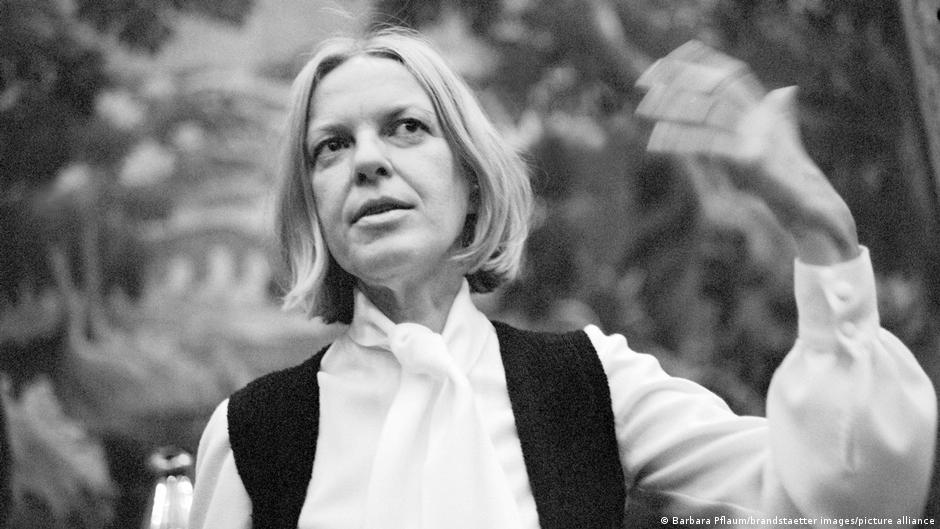
Ingeborg Bachmann: A Century of Enduring Literary Influence
As the centennial of her birth approaches, Austrian poet and author Ingeborg Bachmann is being celebrated anew, with a recent documentary featuring acclaimed actress Sandra Hüller and a surge in scholarly interest. Bachmann, a literary luminary of her era, is recognized for her unflinching examination of patriarchal structures, dysfunctional relationships, and the subjugation of women within society. Her profound insights and innovative use of language continue to captate audiences and scholars alike.
Addressing Post-War Trauma and Societal Norms
The aftermath of the Holocaust presented a monumental challenge for post-war German authors: how to articulate the inexpressible. These writers grappled with the imperative to distance themselves from the Nazi legacy while simultaneously documenting the devastation of bombed cities and the widespread suffering of the populace. They navigated the intricate themes of collective guilt and individual accountability. However, the German-language literary landscape that confronted these formidable issues was largely dominated by male voices, often marginalizing women's contributions as inconsequential. Ingeborg Bachmann, an Austrian anti-fascist and feminist writer, distinguished herself as one of the few women to assert her literary presence within a predominantly patriarchal industry.
Regina Schilling, a long-time admirer of Bachmann and the director of the new documentary, “Ingeborg Bachmann: Someone who was once me,” emphasizes the author's enduring relevance. Schilling's research for the film underscored the visionary and contemporary nature of Bachmann's writings. “She addressed themes that are central to today's social discourse, such as gender identity,” Schilling noted, adding that Bachmann articulated concepts that would later be recognized as “mansplaining.” Schilling concluded that Bachmann was unequivocally “ahead of her time.”
The Power of Language and Personal Emancipation
Bachmann critically engaged with how language itself perpetuated established power dynamics. In her story “Among Murderers and Madmen,” the narrator declares, “No new world without a new language,” highlighting her belief in the transformative power of linguistic innovation.
Born in 1926 in Klagenfurt, Austria, Bachmann's personal background was complex; her father was an early member of the Nazi Party. Although she never publicly discussed this familial connection, this fraught history profoundly influenced her literary output, which frequently explored themes of collective guilt, trauma, and patriarchal violence. Her journey of emancipation began with her departure from her hometown in the Carinthian Alps. She once reflected, “Though I later traveled to Paris, London and Germany, that matters little; for in my memory, the journey from the valley to Vienna will always remain the longest one.”
Bachmann pursued studies in philosophy, psychology, and German literature, culminating in a doctoral thesis on the existentialist philosophy of Martin Heidegger. She was also recognized as an authority on Ludwig Wittgenstein, whose philosophy posited that certain realities defy logical description, suggesting silence as the appropriate response. Bachmann dedicated her literary career to challenging Wittgenstein's assertion, striving through her writing to articulate “the unsayable, the mystical, the limit.”
A Leading Voice in the Avant-Garde
Her work at a US forces radio station in post-war Vienna connected Bachmann with the broader German-language literary community. She was invited to present her poetry at a gathering of Gruppe 47 (Group 47), an influential avant-garde literary collective. This informal association of German-speaking writers, established in 1947, aimed to liberate German literature from the propaganda and corruption of the Nazi era. It served as a launching pad for the careers of major authors such as Heinrich Böll and Günter Grass, as well as Bachmann herself. In 1953, Bachmann received the prestigious Gruppe 47 Literature Prize, the organization's highest honor, for poems featured in her debut collection, “Die gestundete Zeit” (Borrowed Time). These works conjured worlds that were simultaneously hauntingly beautiful and unsettlingly violent. She also achieved success with her radio plays. Her sole completed novel, “Malina,” published in 1971, is widely regarded as her magnum opus. The novel delves into the psychological fragmentation of a female writer entangled in a strained love triangle in Vienna.
Bachmann was engaged in a multi-volume project titled “Ways of Dying” before her untimely death in 1973 at the age of 47. She succumbed to complications following an accidental fire in her Rome apartment. Her tragic demise further solidified her myth, mirroring the existential unraveling and trauma that were central motifs in her literary explorations.
Literary Romances and Enduring Enigma
Bachmann's romantic and intellectual relationships further contributed to her mythical status. In her youth, she formed a profound connection with the Romanian Jewish poet and Holocaust survivor Paul Celan. Despite his marriage to another, their correspondence continued for years, meticulously documenting their intricate love story. This relationship was particularly poignant given their divergent backgrounds: Celan, the only son of Holocaust victims, and Bachmann, the daughter of an early Nazi Party member.
She also shared a significant partnership, both personally and artistically, with Hans Werner Henze, one of Germany's most prominent contemporary music composers. They collaborated on operas and even contemplated marriage. However, due to Henze's homosexuality, Bachmann ultimately withdrew from the platonic union.
Another notable relationship was with the distinguished Swiss playwright and novelist Max Frisch. Their intellectual exchange was intense, though their relationship, which became the most famous in German-language literature, was also fraught with tension. Their letters, published only in 2022, reveal the distress caused to both by their open relationship and extramarital affairs.
The centenary of Ingeborg Bachmann's birth on June 25, 1926, is being marked by several new works. Schilling’s documentary interweaves archival footage, interviews with Bachmann, excerpts from her texts, and improvised scenes featuring Oscar-nominated Sandra Hüller. Another biopic, 'Journey into the Desert Country' by Margarethe von Trotta, starring Vicky Krieps, was released in 2023.
A new autobiography by Andrea Scholl, “Zwei Menschen sind in mir” (Two People Are Within Me), draws upon recently published letters and diary entries. The title encapsulates the central tension in Bachmann's life: the duality between an uncompromising, intellectually brilliant writer and an individual grappling profoundly with addiction, isolation, and self-doubt. Despite the extensive body of work analyzing every facet of Bachmann's writing and life, she remains an enigmatic figure, embodying the characteristics of her modernist masterpiece, “Malina”: a work that is vulnerable yet brave, elegant yet razor-sharp, eerie yet profoundly human.
Source: Why Austrian author Ingeborg Bachmann remains a literary icon