Historic Shift in Hungarian Public Media
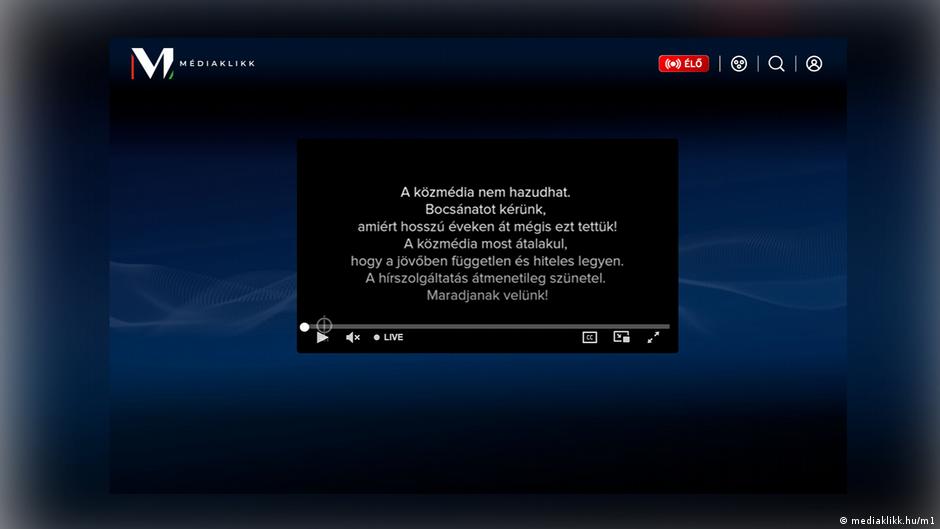
On Tuesday, viewers tuning into Hungary's public service media channel M1 were met with an unprecedented sight: a black screen accompanied by an apology. This event signaled the beginning of a comprehensive reform effort aimed at dismantling a system that critics argue had become a tool for government propaganda under the previous administration.
For nearly four hours, M1 ceased regular broadcasting, displaying a message that read: "Public media should not lie. We are sorry for doing it for so long. Public media will now be reformed so they will be independent and trustworthy. Our news service is currently suspended. Stay tuned!" This apology, and the subsequent announcement of reform, replaced all news bulletins and political programs across Hungary's public television and radio channels. The only exception was the website of the MTI news agency, part of the same public media holding MTVA, which continued to publish political news.
An End to an Era of Disinformation
The period preceding this reform saw Hungarian public service media accused of disseminating extensive disinformation, a situation described by some as unparalleled within the European Union. Content broadcast during this time allegedly included narratives reminiscent of historical propaganda, such as portraying migrants as criminals, a US billionaire of Hungarian Jewish descent as a destroyer of Christian identity, and the EU as promoting "LGBTQ propaganda." Additionally, some reports were criticized for echoing Russian state media narratives, particularly concerning the conflict in Ukraine.
Hungary's Prime Minister, Peter Magyar, marked the occasion with a Facebook post, declaring, "Today marks the end of propaganda broadcasts on public media platforms." He further elaborated, "They lied at night, they lied during the day, they lied on every wavelength. That is now over." This statement underscored the new administration's commitment to transforming the media landscape.
Immediate Leadership Overhaul and Symbolic Rebirth
Beyond the symbolic black screen, tangible changes were swiftly implemented. Key figures within M1, including its director, Zsolt Nemeth, and numerous senior news editors and programming directors, were removed from their positions. This leadership overhaul was a critical step in the reform process, aiming to clear the way for a new, independent direction.
The return to broadcasting at precisely 7:56 p.m. CET was laden with symbolism. The time, 19:56, was chosen to commemorate the 1956 anti-Communist, anti-Soviet revolution in Hungary. The first program aired after the hiatus was "The Witness," a 1979 Hungarian political satire known for its critique of Stalinist propaganda. Even after M1 resumed broadcasting, the black screen and apology remained visible on the website of Hirado, M1's primary news program, serving as a continuous reminder of the commitment to change.
Fulfilling a Core Campaign Promise
The radical restructuring of Hungary's public service media was a central pledge of Peter Magyar's election campaign. Following his Tisza party's significant victory, Magyar consistently criticized the public broadcasters, labeling them a "factory of lies." This stance reflected widespread concerns about how the previous government, under Viktor Orban, had reportedly reshaped both public and much of the privately-owned media to align with its political agenda.
Following his election in 2010, Orban's government revised media legislation, established the National Media and Infocommunications Authority (NMHH), and appointed pro-government figures to key regulatory roles. Public service media were subsequently consolidated under the MTVA holding company, leading to the dismissal or voluntary departure of many independent journalists by 2011. Critics argue that from this point, MTVA outlets increasingly functioned as a government mouthpiece, often repeating official narratives and targeting opposition figures, civil society organizations, and independent journalists. Despite legal obligations for balanced reporting, opposition voices were largely absent, and following the 2022 invasion of Ukraine, MTVA channels were accused of presenting a distorted reality that sometimes mirrored Russian state propaganda.
Broader Media Landscape and Future Steps
The previous administration's influence extended to private media as well. Companies linked to government-aligned individuals acquired private outlets, either bringing them into line or shutting them down, as seen with the daily Nepszabadsag in 2016. In 2018, numerous broadcast, print, and online media outlets were transferred to the Central European Press and Media Foundation (KESMA), effectively consolidating a large portion of the pro-government private media sector.
Looking ahead, a transitional director has been appointed at MTVA, with an interim leadership team now in place for M1. The MTVA has stated that permanent leadership positions will be filled through a public selection process involving social and professional organizations. Plans include establishing a supervisory board for the restructured media holding company, comprising three representatives each from the government majority, the parliamentary opposition, and independent journalists' associations. While many independent journalists have welcomed these changes, they also emphasize the need for genuine participation in the reform process and await further details regarding the government's plans.
The reforms have not been without criticism. Former Prime Minister Viktor Orban, for instance, denounced the restructuring on Facebook, calling it "a new step in the Tisza Party's tyranny." Similar criticism came from opposition lawmaker Balazs Nemeth, a former Hirado news anchor, who declared "Hungarian democracy is dead" after M1's screen went black.
Source: Original Article