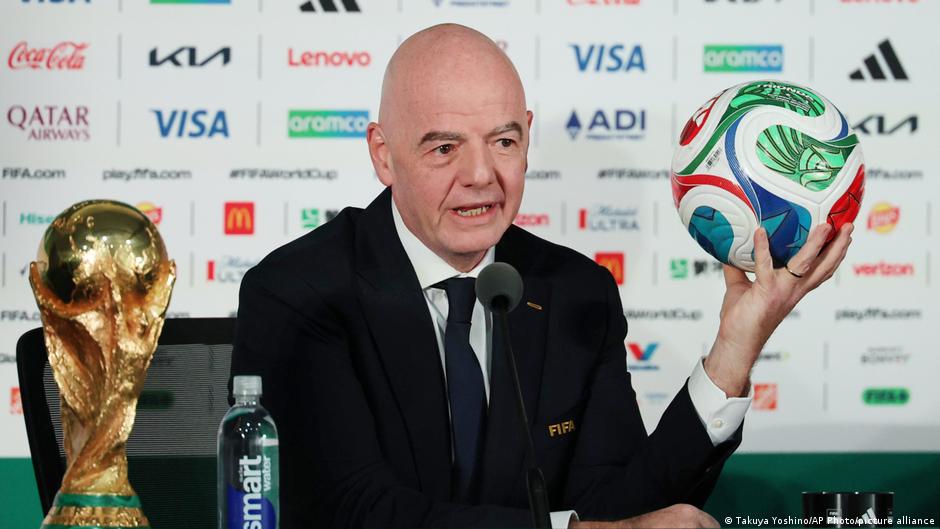
Widespread Frustration with FIFA's Governance
The world of international football is experiencing a period of heightened scrutiny and discontent regarding the governance of its global body, FIFA. Amidst the ongoing World Cup, a series of contentious decisions and alleged political entanglements have intensified criticisms from federations, fans, coaches, and players alike. These issues have contributed to a significant decline in public trust for an organization already facing skepticism.
One of the most recent flashpoints occurred when FIFA controversially suspended the red card ban for USA striker Folarin Balogun just before a critical World Cup match against Belgium. This decision, which was reportedly influenced by US President Donald Trump, directly contradicted FIFA's own statutes prohibiting the review of red cards during the tournament and any form of political interference. Trump publicly claimed responsibility for the decision, stating, "I'm the one that got them to do it," a sentiment echoed by many observers despite FIFA's insistence that its disciplinary committee made the ruling. This incident, coupled with sky-high ticket prices, visa denials for fans and officials, and the perceived omnipresence of both FIFA and Trump throughout the tournament, has fueled widespread dissatisfaction.
Eroding Trust and Unilateral Decisions
Several factors have contributed to the erosion of trust in FIFA. A particularly controversial moment was the awarding of FIFA's inaugural Peace Prize to President Trump last December, a move reportedly initiated unilaterally by FIFA President Gianni Infantino. This decision came shortly before Trump engaged in conflict with Iran, a participating nation in the tournament, further alienating both internal and external stakeholders.
Concerns also extend to FIFA's World Cup hosting policies. While a rotation system is ostensibly in place, the scheduling of matches for the 2030 World Cup across Europe, Africa, and South America seemingly paved the way for Saudi Arabia to secure the 2034 tournament unchallenged, much earlier than Asia would typically be due. This arrangement, combined with Infantino's potential to extend his presidency beyond the customary 12-year limit, largely unopposed, has led many to conclude that frustration with FIFA has reached an unprecedented level.
FIFA's Power Structure and Commercial Influence
FIFA's enduring power stems from its dual role as both the global developer of the sport and its primary commercial operator. The World Cup remains its most significant financial driver, though the recently expanded Club World Cup is increasingly contributing to its revenue. This expansion, however, has drawn criticism from players and player unions regarding an already congested calendar and the unreasonable demands placed on athletes. England striker Harry Kane notably commented last year, "I don't think the players are listened to that much, if I'm totally honest."
Structurally, FIFA's system grants each of its 211 member nations a single vote for the president every four years. These member associations subsequently receive financial rewards through various programs, a system that governance experts argue consolidates power. Miguel Maduro, a former chairman of FIFA's Governance, Audit and Compliance Committee, explained, "The commercial dimension is the bedrock of FIFA's system of power. The money is used by the presidents to accumulate and consolidate their power." Maduro, who was dismissed in 2017 after attempting to enforce political neutrality rules regarding Russia, added that this system supports a patronage network where loyalty is rewarded, and criticism is stifled, explaining why incumbents often face no opposition.
External Pressure for Reform
Given the internal mechanisms that entrench FIFA's power, many believe that external intervention is necessary for meaningful reform. Nick McGeehan of the human rights NGO FairSquare suggests that political intervention, particularly from the European Union, could be the most effective catalyst for change. "It requires political intervention. There is no other way to fix FIFA," he stated, suggesting the EU could regulate sport similar to how it regulates other sectors like Big Tech.
FairSquare has already filed a complaint with the Investigatory Chamber of the FIFA Ethics Committee concerning Infantino's dealings with Trump. Separately, fan group Football Supporters Europe (FSE) and advocacy group Euroconsumers lodged a complaint with the European Commission regarding World Cup ticket prices. While the Commission has not indicated an intention to directly challenge FIFA's overall governance, a spokesperson confirmed that the complaints are being processed and that EU laws, while not regulating price levels, do mandate transparency and prohibit misleading commercial practices for event tickets.
Tensions with UEFA and the Prospect of a Breakaway
Significant tensions exist between FIFA and UEFA, Europe's powerful football federation. The Balogun incident brought these tensions to a head, with UEFA releasing a statement expressing "disbelief at such an unprecedented, incomprehensible and unjustifiable decision" and asserting that FIFA had "crossed a red line." Earlier in the tournament, UEFA's decision to hire Somalian referee Omar Artan for the Super Cup final, days after he was denied entry to the US for the World Cup, further highlighted the rift. UEFA President Aleksander Ceferin emphasized that "Football is made to connect people."
These disagreements have led some to speculate about the possibility of a breakaway from FIFA, potentially spearheaded by UEFA. Geoff Walters, a professor in sports business at the University of Liverpool, notes that if any such movement were to occur, it would likely originate from UEFA or a coalition of European nations. However, he also highlights the inherent risks for federations in challenging FIFA, including potential repercussions on hosting bids and international standing. The German FA, for instance, after a political gesture in the 2022 World Cup, has since moderated its stance on political activism, possibly with future hosting bids in mind. Despite this, German FA President Bernd Neuendorf did speak out on the Balogun incident, emphasizing the need to dispel any impression of political interference to maintain the integrity of the competition and FIFA's credibility.
Even UEFA, however, has faced its own governance challenges, including the threat of an elite-club-driven Super League in 2021, and, as Maduro points out, "suffers from that same governance flaws as FIFA, albeit in a less obvious and radical manner."
The Global Impact and FIFA's Defense
A significant hurdle for any potential breakaway lies in maintaining global unity and support for smaller nations. UEFA President Ceferin's reported comments that an expanded World Cup makes many matches "completely uninteresting" were met with strong rejection from 13 African and Asian football associations, indicating a potential divide. Walters explains that the influence of Europe and South America is not as strong as it once was, compared to Infantino's power base in Asia and Africa. He questions what would happen to smaller nations' ability to develop football in their countries if larger entities were to break away, suggesting that such a move could exacerbate existing inequalities.
FIFA, for its part, defends its commercial motivations by arguing that all generated revenue is reinvested into football, particularly in regions neglected by other organizations. Infantino stated, "Every dollar we generate goes back into football... We invest in countries where no one else does — South Sudan, Bhutan. No one else is doing this." While discontent is undeniably high, FIFA's deep entrenchment in global football and its unique ability to fund development in diverse regions make a complete breakaway a remote possibility. Without a unified and determined effort from a significant alliance of countries or influential individuals, the prospects for substantial reform within FIFA remain challenging.
Source: Could football break away from FIFA and its World Cup?